 Book Free Consultation
Effective change management is no longer a periodic disruption to be managed and forgotten; it’s the permanent condition of modern enterprise. The change management process must be embedded into organisational DNA. Research by McKinsey & Company (2023) reveals that 70% of large-scale transformation programmes fail to achieve their objectives, not because the strategies are technically flawed, but because the human factors of change are underestimated or outright ignored.
For senior leaders, people managers, and transformation practitioners driving organisational change, the question is no longer whether change is necessary, but how it can be led with rigour, empathy, and measurable impact. Successful change management demands a structured approach that addresses the entire organisation from executive sponsors to frontline employees.
A critical distinction that practitioners must internalise is the difference between change management and project management. Project management concerns the technical side of delivering a solution; scope, timeline, cost, and quality. Change management concerns the adoption of that solution; whether people actually use it, support it, and sustain it. Both disciplines are essential, and their integration is one of the strongest predictors of transformation success.
This guide provides an end-to-end, evidence-based framework for effective change management from foundational theory to practical execution. It is designed for professionals who need substance over slogans and structured thinking over generic checklists. Whether you are managing people through a digital transformation, implementing new technology, or entering new markets, this guide delivers the tools and insight you need.
1. What Is Change Management?
Change management is the discipline of guiding individuals, teams, and organisations from a current state through a transition period to a desired future state. It encompasses the processes, tools, and techniques used to manage the human factors of change in order to achieve required business outcomes. At its core, organisational change management is about enabling people to move from the status quo to a new, desired outcome.
According to the Best Practices in Change Management report (2023), projects with excellent change management are six times more likely to meet their objectives than those with poor change management.
1.1 Types of Organisational Change
Organisational change manifests across several dimensions. Understanding which type — or combination — is involved in a given initiative is foundational to leading change successfully:
- Structural change: Alterations to hierarchy, roles, reporting lines, or team composition
- Process change: Redesign of workflows, operational procedures, or service delivery models
- Technological change: Implementation of new technology, platforms, or digital tools
- Cultural change: Shifts in an organisation’s culture, values, and underlying behavioural norms
- Strategic change: Pivots in direction, business model, or entry into new markets
2. The Change Management Process
A structured change management process provides the backbone for every successful organisational change initiative. Without a clearly defined process, even the most well-intentioned change projects become reactive, inconsistent, and difficult to sustain. Understanding the change process end-to-end and knowing how to adapt it to the scale and complexity of each initiative is a core competency for change managers and project managers alike.
The change management process is not a linear checklist. It is a dynamic, iterative cycle that runs in parallel with the technical side of any transformation programme. Whilst project managers focus on delivering the solution on time and within budget, change managers focus on ensuring the entire organisation is ready, willing, and able to adopt it.
2.1 The Five Stages of the Change Management Process
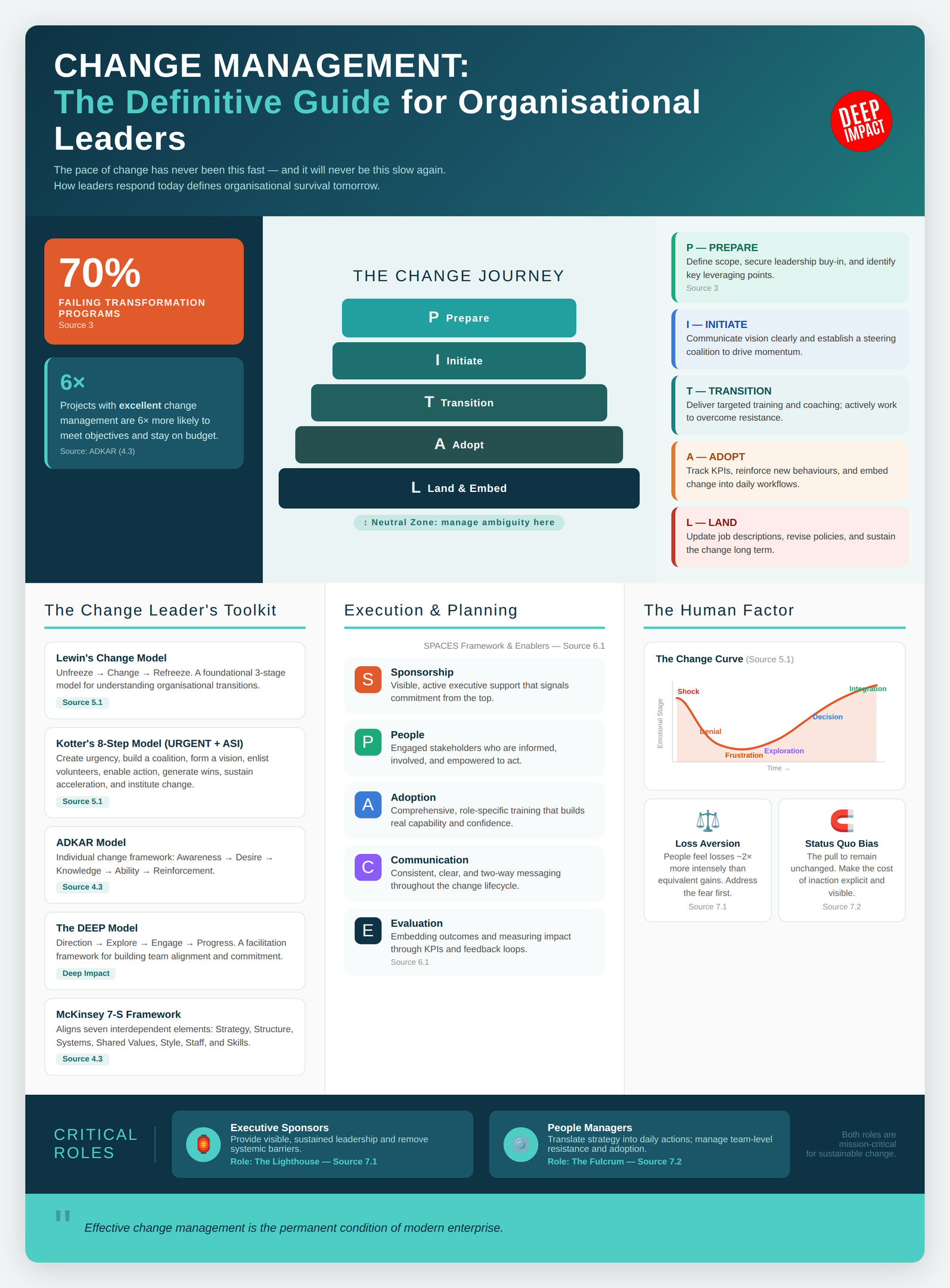
Regardless of which change management model is applied, most structured approaches to implementing change share five fundamental stages. Use PITAL to recall them in sequence:
PITAL — The Five-Stage Change Management Process: Prepare · Initiate · Transition · Adopt · Land Memory phrase: “People In Transition Always Land” — a reminder that the human journey is the process.
P — Prepare (Define and Diagnose) Before any change initiative begins in earnest, the groundwork must be laid. The Prepare stage involves defining the scope and scale of the change, identifying key stakeholders, securing leadership commitment, and conducting an initial change impact assessment. This is where change managers gain insight into the organisation’s readiness for change; its culture, its history with previous change projects, and the likely sources of resistance.
Key activities at this stage include defining the desired outcome, establishing the change management team and governance structure, aligning project managers and change managers on an integrated delivery approach, and developing the initial change management plan. Skipping or rushing the Prepare stage is one of the most common underlying causes of change failure.
I — Initiate (Build Awareness and Desire) With the foundations in place, the Initiate stage focuses on launching the change and building the conditions for employee buy-in. Key stakeholders must understand why the change is happening, what the strategic vision looks like, and what is at risk if the status quo is maintained.
The guiding coalition identified during the Prepare stage becomes active here, amplifying the change narrative, addressing concerns from key stakeholders, and ensuring that communication reaches the entire organisation through the right communication channels. Leadership commitment must be visible and consistent from the first day of launch.
T — Transition (Enable and Support) The Transition stage is the heart of the change management process and the most demanding. This is where people move through the neutral zone: the period of genuine uncertainty between letting go of the old way and fully embracing the new. Performance and morale typically dip during this stage, and the risk of resistance peaking is highest.
Change managers focus on enabling change through targeted employee training, on-the-job coaching, and the removal of structural and procedural barriers. People managers play a pivotal role here, translating strategic intent into day-to-day support and providing the clear direction their teams need to navigate uncertainty. Short-term wins should be identified and celebrated to build momentum and demonstrate that the change process is working.
A — Adopt (Embed and Reinforce) As individuals begin to demonstrate the new behaviours and engage with new processes, the Adopt stage focuses on reinforcing and sustaining that progress. It is not enough for people to know what to do; they must be supported to do it consistently, and recognised when they do.
Key performance indicators should be tracked and reported at this stage, providing evidence of adoption against the baseline established during the change impact assessment. Where adoption gaps are identified, change managers can use the ADKAR model diagnostically to pinpoint whether the barrier is one of knowledge, ability, or reinforcement, and intervene accordingly. The goal is to sustain outcomes, not just achieve them once.
L — Land (Sustain and Close) The final stage of the change management process is often the most neglected. Landing the change means ensuring that new processes, behaviours, and ways of working are fully embedded in the organisation’s culture, and that the conditions for regression are removed. This corresponds to the Refreeze stage in Lewin’s model and the Institutionalise step in Kotter’s framework.
Landing activities include updating job descriptions, performance metrics, and organisational policies to reflect the new ways of working; formally closing the change management workstream; and documenting lessons learned for future change projects. Critically, ownership of the change must also transition from the project team to the business, ensuring that successful change management outlasts the programme that created it.
2.2 The Change Management Process vs. The Project Management Process
One of the most important structural decisions in any transformation programme is how to integrate the change management process with the project management process. These two disciplines are complementary, but they operate on different logic:
| Dimension | Project Management | Change Management |
|---|---|---|
| Primary focus | Technical delivery | People adoption |
| Measures success by | On time, on budget, on scope | Utilisation, proficiency, sustained outcomes |
| Key roles | Project managers, workstream leads | Change managers, people managers, sponsors |
| Core tools | Project plan, RAID log, governance framework | Change management plan, stakeholder map, ADKAR assessment, DEEP Model |
| Risk lens | Delivery risk | Adoption risk and resistance |
| End point | Solution go-live | Full embedding in organisation’s culture and operationalised into daily activities |
Organisations that treat project management and change management as separate, siloed disciplines consistently underperform against those that integrate them from the outset. The most effective change projects establish a single, unified programme structure in which change managers and project managers work shoulder-to-shoulder from the Prepare stage through to Landing.
2.3 Adapting the Process to the Scale of Change
Not every change initiative requires the same level of change management investment. A key skill for change managers is calibrating the depth and intensity of the change management process to the scale, complexity, and risk profile of the change. A useful framework for this calibration considers three dimensions:
Scope: How much of the entire organisation is affected? A change that touches a single team requires a fundamentally different approach to one that spans multiple geographies, business units, or levels of hierarchy.
Depth: How significantly does the change alter day-to-day working life for those affected? Implementing new technology that changes every aspect of how people work demands a deeper change management investment than a process adjustment that affects a small number of tasks.
Disruption: How much does the change conflict with the existing organisation’s culture, established habits, or current ways of working? Transformational change that challenges deeply held values or established power structures requires proportionally greater attention to the human factors throughout every stage of the change management process.
Assessing these three dimensions at the outset enables change managers to make evidence-based decisions about where to invest their effort, and build a proportionate, targeted change management plan that focuses resources where they will have the greatest impact on the desired outcome.
3. The Business Case for Structured Change Management
Many organisations still treat change management as an optional add-on, a communication plan attached to a change project at the eleventh hour. The evidence argues decisively against this approach. A structured process for managing change is a critical aspect of delivering business results.
3.1 The Cost of Failed Change Is Massive; the Return on Getting it Right Is Even Bigger.
| Statistic | Source |
|---|---|
| 70% of transformation programmes fail to meet their goals | McKinsey & Company, 2023 |
| Organisations with excellent change management are 6x more likely to succeed | Prosci, 2023 |
| Companies with strong change capabilities deliver 143% higher shareholder returns vs peers | WTW, 2022 |
| Only 34% of employees are actively engaged during large-scale change | Gallup, 2022 |
| Fortune 500 companies lose approximately $660 billion annually from poorly managed change | IBM Institute for Business Value, 2022 |
| 87% of organisations applying a structured methodology report positive ROI | Prosci, 2023 |
The financial stakes are equally compelling. The return on investment from structured change management is well documented; organisations that apply a rigorous change management plan consistently report faster adoption, higher sustained utilisation, and stronger outcomes against strategic goals.
4. Foundational Change Management Models and Frameworks
Effective change management is grounded in management research. A working knowledge of the foundational change management models equips practitioners to make informed choices about methodology. No single model is universally applicable, the most capable change managers draw from multiple frameworks depending on the context of the change initiative.
4.1 Lewin’s Three-Phase Model (1947)
Kurt Lewin’s model remains one of the most enduring in the field. It conceptualises change in three phases, a structured process that has informed virtually every subsequent change management model.
UCR — Lewin’s Three Phases: Unfreeze · Change · Refreeze Memory phrase: “Unclip, Change, Resecure” — think of a safety clasp being released, repositioned, and locked again.
U — Unfreeze: Challenge the status quo and surface dissatisfaction with the current state. Build psychological readiness across the organisation before the transition begins. Overcoming resistance starts here. Key actions: leadership alignment, communication of the “why”, burning platform narrative.
C — Change: The active period of transition during which people are learning, adjusting, and adapting. Uncertainty is highest here — this is the neutral zone where clear direction and visible, empathetic leadership are essential. Key actions: training delivery, manager coaching, communication cadence, barrier removal.
R — Refreeze: Stabilise and institutionalise the change. Update job descriptions, key performance indicators, and processes to reflect new processes and the new way of working. Celebrate and reinforce to prevent regression. Key actions: policy updates, recognition programmes, reinforcement communications.
Whilst the model has been critiqued for oversimplifying the non-linear nature of change, its core insight that change requires deliberate unfreezing and refreezing — remains highly relevant, particularly for cultural change affecting an organisation’s culture at the deepest level.
4.2 Kotter’s 8-Step Model (1996)
John Kotter’s model, developed from management research into over 100 companies, is widely used in corporate settings for leading change. Research cited in Kotter’s Leading Change (2012 revised edition) indicates that organisations which skip early steps, particularly step one, experience significantly higher failure rates. Use URGENT + ASI to recall all eight steps:
U — Urgency (Step 1): Present a compelling, evidence-based case for why organisational change must happen now. Without genuine urgency, the guiding coalition will not form, and the organisation will not move beyond the status quo.
R — Rally (Step 2): Build a guiding coalition — a cross-functional group with sufficient authority, credibility, and leadership commitment to lead the change. This coalition must extend beyond the project team to key stakeholders across the entire organisation.
G — Goal (Step 3): Form a strategic vision — clear, compelling, and communicable. Simple enough to explain in two minutes, specific enough to provide clear direction and guide decisions throughout the change process.
E — Enlist (Step 4): Enlist a volunteer army. Communicate the vision broadly and engage employees not merely as recipients of information but as active participants in enabling change. Employee buy-in is built here.
N — Navigate (Step 5): Enable action by removing barriers — structural, procedural, and behavioural obstacles that prevent people from acting on the strategic vision and embracing change.
T — Traction (Step 6): Generate short-term wins — visible, meaningful successes that demonstrate progress, build credibility, and silence sceptics. Short-term wins are essential to maintain momentum.
A — Accelerate (Step 7): Sustain acceleration. Use credibility earned from early wins to tackle larger challenges. Resist the temptation to declare victory too soon — a critical pitfall in many change projects.
S — Solidify (Step 8): Anchor new approaches in the organisation’s culture by connecting them to business success and promoting those who embody the new ways of working.
I — Institutionalise (Step 8, cont.): Institute change in company culture. Ensure the change outlasts the individuals who led it — woven into culture, not dependent on a single champion or change manager.
4.3 The ADKAR Model
Developed by Jeff Hiatt the ADKAR model is an individual-focused change management model that tracks the five building blocks a person must achieve to make change succeed. The methodology positions ADKAR as its central diagnostic tool when a change initiative stalls, change managers can use it to pinpoint precisely where individuals are struggling.
ADKAR — Awareness · Desire · Knowledge · Ability · Reinforcement The acronym is the model. Each letter is both the memory aid and the diagnostic tool.
A — Awareness (of the need for change): People must understand why the change is happening and the risk of not changing. Awareness is created through communication, not information broadcast alone, but honest dialogue. Practitioner question: “Do our people understand why this change is happening?” Primary lever: Communication strategy and leadership messaging.
D — Desire (to support and participate): Desire cannot be mandated. It is shaped by what the individual stands to gain or lose, their trust in leadership, and the visible support of their people managers. Practitioner question: “Do our people want to make this change happen?” Primary lever: Manager engagement, addressing loss concerns.
K — Knowledge (of how to change): Once someone has awareness and desire, they need to know precisely what to do differently. This is the domain of employee training, job aids, process documentation, and coaching. Practitioner question: “Do our people know what to do and how to do it?” Primary lever: Training programmes, coaching.
A — Ability (to implement new skills and behaviours): The gap between knowing and doing is significant. Ability is developed through practice, feedback, and time, particularly where new processes conflict with deeply embedded habits. Practitioner question: “Can our people actually perform the new way of working?” Primary lever: On-the-job support, feedback loops.
R — Reinforcement (to sustain the change): Without active reinforcement, regression to the status quo is inevitable. Recognition, updated processes, and clear consequences for reverting all serve to sustain outcomes. This stage is the most commonly neglected, and its neglect is why so many change initiatives do not stick. Practitioner question: “Are we sustaining the change over time?” Primary lever: Recognition programmes, key performance indicators.
4.4 The McKinsey 7-S Framework
Originally developed by Tom Peters and Robert Waterman at McKinsey, the 7-S framework considers seven interdependent elements of organisational change management. Its value lies in its systemic perspective — prompting change leaders to assess how a proposed change ripples across all dimensions of the entire organisation.
3S · 3S · V — McKinsey 7-S Framework Memory aid: “Hard things are Shaped by Structure and Systems. Soft things are Shaped by Style, Staff, and Skills. All held together by Shared Values.”
Hard Elements (tangible, directly manageable):
S — Strategy: The organisation’s plan for achieving its strategic goals. During change, ask: does the proposed change align with and reinforce the strategy, or does it create contradiction?
S — Structure: Reporting lines, hierarchy, and the division of roles. Structural change is often the most visible, and most contentious element of transformational change.
S — Systems: The processes, procedures, and platforms through which work is done. New technology implementations are fundamentally systems changes, and they rarely succeed without attention to the softer elements.
Soft Elements (culture-driven, harder to shift, but often determinative):
S — Style: The leadership approach that characterises the organisation. Leadership competency and management style make the company culture visible in day-to-day behaviour.
S — Staff: The people within the organisation; their capabilities, motivations, and the talent pipeline. Change projects that ignore the human resources dimension consistently underperform.
S — Skills: The competencies that exist within the organisation. Implementing change that requires skills the organisation lacks must include a credible professional development plan.
V — Shared Values (the core): Shared values connect and influence every other element. Any change that conflicts with deeply held organisational values will face disproportionate resistance, a critical aspect of any impact assessment.
4.5 The DEEP Model™
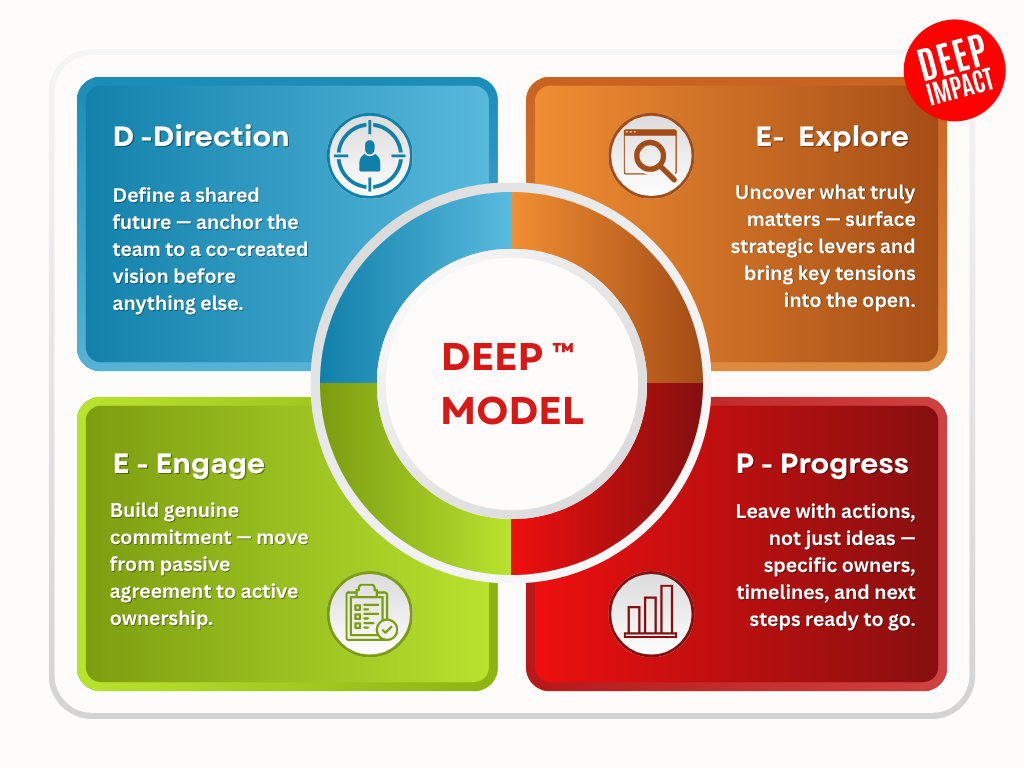
Most facilitated sessions generate energy in the room but leave teams without a clear path forward. The DEEP Model™ is a proprietary facilitation framework that changes that guiding teams through a structured journey from open discussion to co-created decisions and concrete actions, all in a single session.
D — Direction: Define a shared future. Every productive conversation starts with clarity on where the team is headed. The Direction phase anchors discussion to a compelling, co-created vision, shifting focus away from current problems and toward the future the team wants to build. This sets the tone for everything that follows.
E — Explore: Uncover what truly matters. With direction established, the conversation turns to identifying the strategic levers that will drive meaningful change. Ideas are surfaced, priorities are tested, and key tensions are brought into the open, ensuring the most important issues are addressed, not avoided.
E — Engage: Build genuine commitment. A strategy is only as strong as the people behind it. The Engage phase moves participants from passive agreement to active ownership, working through concerns, aligning on trade-offs, and arriving at a shared course of action that everyone is genuinely committed to.
P — Progress: Leave with actions, not just ideas. The final phase translates discussion into a concrete plan with specific owners, timelines, and next steps ready for immediate implementation. Ideas don’t stay on the whiteboard. Progress begins before the session ends.
5. The Psychology of Change
Understanding why people resist change is as important as understanding what change to implement. Overcoming resistance begins with recognising that resistance is not pathological; it is a rational human response to uncertainty, perceived loss, and disruption to identity. Effective change leaders treat resistance as data, not dysfunction.
5.1 The Change Curve
Adapted from Elisabeth Kübler-Ross’s grief model, the Change Curve describes the emotional journey individuals typically experience during organisational change. Effective change managers use the curve as a diagnostic lens to map communications and interventions to each stage. Research by Deloitte (2022) found that organisations which explicitly mapped support to emotional stages reported 31% higher adoption rates.
SDFEDI — Shock · Denial · Frustration · Exploration · Decision · Integration Memory phrase: “Some Days Feel Especially Difficult Indeed”
S — Shock: The immediate reaction to the announcement. People may appear numb or withdrawn. Change leaders must communicate clearly and with empathy. Leader priority: Clarity and reassurance. Avoid information overload.
D — Denial: People minimise the impact “this won’t really affect my role.” Leaders should reinforce the reality of the change without dismissing individual concerns. Leader priority: Consistent, honest communication — do not allow ambiguity to breed false hope.
F — Frustration: Resistance peaks. Anger, blame, and visible disengagement surface. Suppressing this stage makes it worse. Create structured dialogue channels and acknowledge legitimate concerns a critical aspect of overcoming resistance. Leader priority: Active listening, visible empathy.
E — Exploration (the neutral zone): People begin tentatively testing new processes. Performance is low, but direction has shifted. This is when employee training, coaching, and practical support have the greatest impact. Leader priority: Quick wins, celebration of early adopters.
D — Decision: Individuals commit to embracing change. Confidence grows alongside competence. Recognise and reinforce this commitment visibly. Leader priority: Recognition, reinforcement, role modelling.
I — Integration: The new way becomes part of the organisation’s culture. People stop thinking of it as “the change” and simply think of it as “how we work.” Leader priority: Embed, sustain, and document lessons for future change projects.
5.2 Loss Aversion and Status Quo Bias
Behavioural economics offers additional explanatory power for understanding the underlying causes of resistance. The work of Kahneman and Tversky (1979) on prospect theory demonstrates that individuals feel losses approximately twice as intensely as equivalent gains. In a change context, employees who perceive threats to their current role, status, or working patterns will require proportionally greater evidence of benefit before they engage constructively.
This has direct implications for communication strategy: change managers must not simply articulate what is to be gained, but must explicitly address and where possible, mitigate what is perceived to be at risk. To reduce resistance, make the case for change personal, specific, and credible.
5.3 The Role of Psychological Safety
Amy Edmondson’s management research at Harvard Business School (1999, updated 2018) on psychological safety has significant implications for organisational change management. Psychological safety, the belief that one can speak up, raise concerns, and make mistakes without punishment, is a key enabler of adaptive behaviour during change. Organisations with high levels of psychological safety demonstrate greater agility when implementing change.
Google’s Project Aristotle (2016) identified psychological safety as the single most important factor in high-performing teams, further validating its relevance in large-scale change programmes. Building psychological safety is a leadership competency that underpins all effective change management.
6. Building a Change Management Plan
A change management plan is not a document; it is a set of deliberate, integrated choices about how to lead people through a transition. A robust plan addresses the entire organisation and encompasses the following elements. Use SPACES as a rapid health-check across any change initiative:
SPACES — Change Strategy Health-Check
- S — Sponsorship: Active, visible executive support and leadership commitment
- P — People: Stakeholder engagement and managing people through transition
- A — Adoption: Employee training and capability building
- C — Communication: Two-way, tailored messaging across all communication channels
- E — Evaluation: Key performance indicators and measurement
- S — Sustainability: Reinforcement and embedding to sustain outcomes
6.1 Stakeholder Engagement and Analysis
Not all key stakeholders are equal in their influence or impact. Effective stakeholder engagement begins with a well-constructed stakeholder map that segments individuals and groups by their level of support, degree of influence, and proximity to the change. From this analysis, tailored engagement strategies are developed — ensuring that key stakeholders are actively cultivated as advocates, those who are resistant receive additional dialogue, and passive individuals are proactively informed before their ambivalence becomes opposition.
The Best Practices in Change Management report (2023) identifies executive sponsorship as the single most important factor in change success, cited by 53% of participants. Leadership commitment at the highest level is non-negotiable.
6.2 Change Impact Assessment
A change impact assessment (CIA) is a structured evaluation of how a proposed change will affect different groups within the entire organisation. It typically considers changes to roles and responsibilities, new processes and ways of working, new technology and systems, key performance indicators, and physical working environment.
The CIA informs the design of employee training, communications, and support structures, and provides a baseline for measuring adoption. Organisations that conduct formal impact assessments at the outset are significantly better placed to manage the change process effectively — a finding supported by the CIPD (2022).
6.3 Communication Planning
A change communication plan answers four questions for every audience across all relevant communication channels:
What is changing?
Why is it changing?
What does it mean for me specifically?
What do I need to do, and by when?
Research by Towers Watson (2013) found that companies that communicate effectively during change initiatives are 3.5 times more likely to outperform their peers.
Critically, communication must be two-way, creating structured mechanisms for feedback, questions, and genuine dialogue, not merely broadcasting information downwards. Employee buy-in is built through honest conversation, not one-way announcements. Major change requires sustained, multi-channel communication throughout the change process.
6.4 Employee Training and Capability Development
Knowledge and ability, two of the ADKAR model’s five building blocks, cannot be assumed. Even motivated employees will struggle to adopt new ways of working if they lack the competence to do so. A training needs analysis should be conducted for each affected role group, distinguishing between those who need fundamental skills development, those who require focused upskilling, and those for whom awareness-level communication is sufficient.
Effective employee training draws on evidence-based principles: spaced practice, retrieval exercises, and application in realistic contexts consistently outperform one-off classroom delivery. Professional development should be positioned as an enabler of the desired outcome, not a compliance exercise.
7. The Role of Leadership in Change
Leadership behaviour during change is perhaps the most powerful variable of all. Change leaders shape company culture, model behaviours, and determine through their actions far more than their words whether a change is real or performative. Leadership competency in managing people through transition is a critical aspect of any change management plan.
7.1 Sponsor Roles and Responsibilities
The role of the executive sponsor is distinct from, and complementary to, the role of the change manager or project owner. Sponsors are responsible for actively and visibly championing the change, communicating the rationale from a position of authority, removing systemic barriers, building and maintaining the guiding coalition, and staying engaged throughout the transition.
In our experience in Deep Impact, a lack of senior leadership engagement is one of the top contributors to adoption failure. Leadership commitment must be sustained, not front-loaded. Change leaders who remain visibly involved throughout change projects consistently achieve better outcomes.
7.2 People Managers as Change Agents
People managers are the fulcrum of any large-scale organisational change. They translate strategic vision into operational reality, and they are the primary point of contact for employees navigating uncertainty. Despite their centrality, people managers are frequently under-supported during change, expected to lead others through a transition whilst managing their own concerns.
We have noticed that when people managers are well prepared, employee adoption rates improve significantly. Investing in manager readiness, through briefings, talking points, coaching, and access to change specialists, should be a non-negotiable element of any change management plan. Managing people through major change is a professional development priority.
7.3 Authentic Leadership and Transparency
Trust is the currency of effective change leadership. Edelman’s Trust Barometer (2023) found that 63% of employees trust their employer less when communication during change is perceived as dishonest or incomplete. Authenticity, being willing to acknowledge uncertainty, admit what is not yet known, and invite dialogue, paradoxically builds more trust than polished, over-scripted messaging.
Change leaders who model the behaviours they are asking others to adopt, and who demonstrate genuine empathy for the human factors of change, are significantly more effective at sustaining engagement. Clear direction, delivered authentically, is the foundation of employee buy-in.
8. Measuring Change Management Effectiveness
One of the persistent weaknesses in change management practice is the absence of rigorous measurement. Without data, change managers cannot demonstrate value, diagnose problems early, or make evidence-based adjustments. A comprehensive measurement framework operates at three levels:
8.1 Activity Metrics
Activity metrics confirm that the change management plan is being executed. They include volume of communications delivered, percentage of target audience attending employee training, number of stakeholder engagement sessions conducted, and manager readiness assessments completed. Whilst necessary, activity metrics are insufficient on their own — they measure inputs, not outcomes.
8.2 Adoption Metrics
Adoption metrics assess whether people are actually using new processes, systems, or behaviours. Examples include system login rates, process compliance rates, and quality of outputs under new ways of working. Tracking adoption at defined milestones, at go-live, 30 days post, 60 days post, and beyond, allows for timely corrective intervention where gaps are identified. These are the key performance indicators that determine whether change initiatives are succeeding.
8.3 Outcome Metrics
Outcome metrics link the change initiative to the business results it was designed to achieve, the desired outcome of the entire change process. They include productivity improvements, customer satisfaction scores, error rates, cost reductions, and employee engagement indices. Connecting change management activity to business outcomes against strategic goals is the most compelling means of demonstrating return on investment from enterprise change management.
9. Common Pitfalls and How to Avoid Them
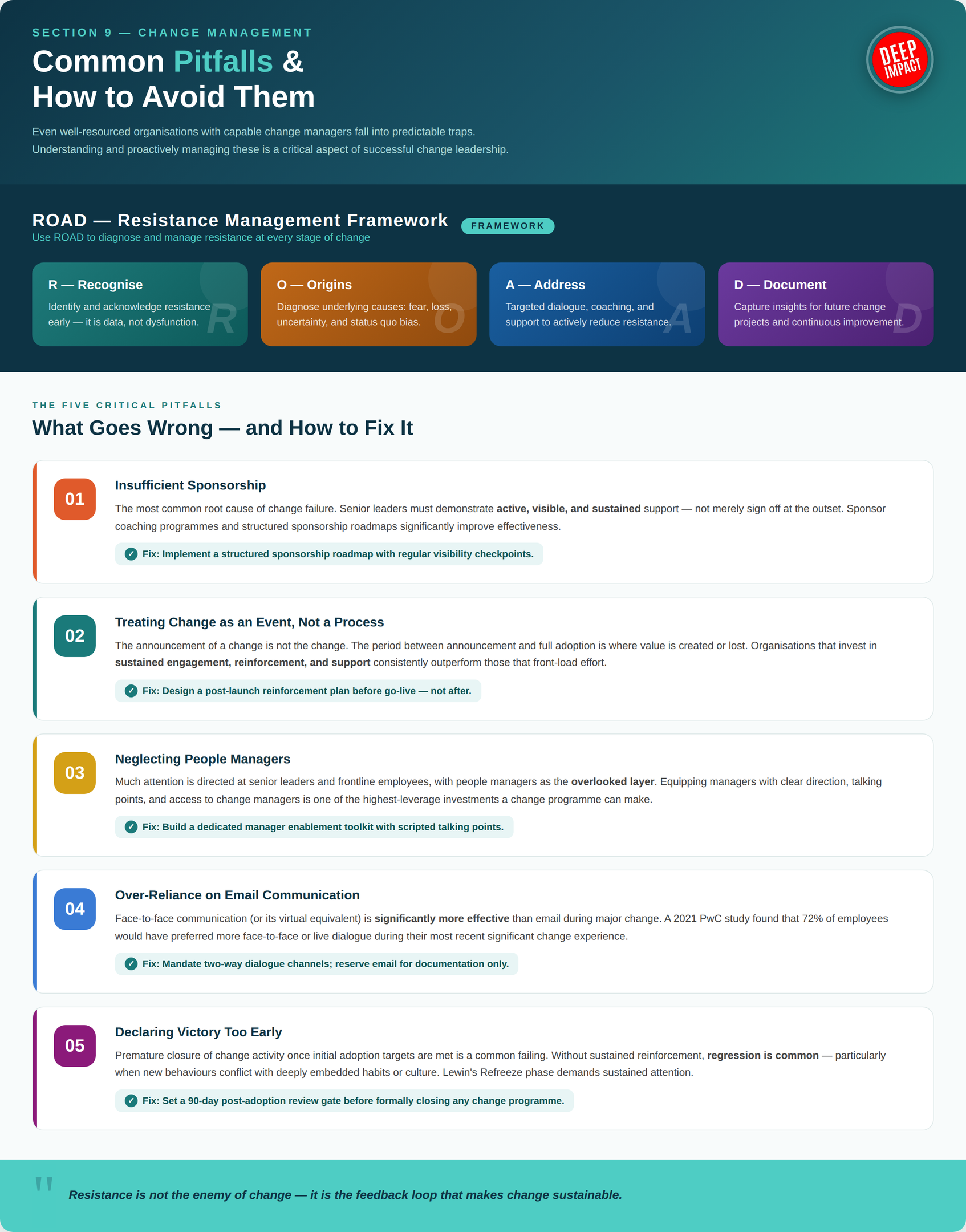
Even well-resourced organisations with capable change managers fall into predictable traps during change. Understanding these pitfalls, and managing people proactively through them, is a critical aspect of successful change management. Use ROAD to diagnose and manage resistance at every stage:
ROAD — Resistance Management Framework
- R — Recognise: Identify and acknowledge resistance early — it is data, not dysfunction
- O — Origins: Diagnose the underlying causes (fear, loss, uncertainty, status quo bias)
- A — Address: Targeted dialogue, coaching, and support to reduce resistance
- D — Document: Capture insights for future change projects and continuous improvement
Insufficient Sponsorship. The most common root cause of change failure. Senior leaders must demonstrate leadership commitment through active, visible, and sustained support — not merely sign off on the programme at the outset. Sponsor coaching programmes and structured sponsorship roadmaps can significantly improve sponsor effectiveness across change projects.
Treating Change as an Event Rather Than a Process. The announcement of a change is not the change. The period between announcement and full adoption is where value is created or lost. Organisations that invest in sustained engagement, reinforcement, and support throughout the structured process consistently outperform those that front-load effort. Implementing change is a continuous improvement discipline, not a one-time event.
Neglecting People Managers. Much change management attention is directed at senior leaders and frontline employees, with people managers as the overlooked layer. Equipping and supporting managers to lead their teams through change with clear direction, talking points, and access to change managers is one of the highest-leverage investments a change programme can make.
Over-Reliance on Email Communication. Research consistently shows that face-to-face communication or its virtual equivalent, is significantly more effective than email during major change. A 2021 study by PwC found that 72% of employees would have preferred more face-to-face or live dialogue during their most recent significant change experience. Communication channels must be chosen deliberately and include mechanisms for employee buy-in through two-way dialogue.
Declaring Victory Too Early. A common failing is the premature closure of change management activity once initial adoption targets are met. Without sustained reinforcement to sustain outcomes, regression is common, particularly when implementing change involves new behaviours that conflict with deeply embedded habits or an organisation’s culture. The Refreeze phase of Lewin’s model demands sustained attention.
10. Change Management in a Digital and Hybrid Context
The post-pandemic working environment has fundamentally altered the context in which change projects are managed. Hybrid and remote working arrangements have fragmented the traditional communication infrastructure, the spontaneous corridor conversation, the all-hands meeting in a shared space, visible walk-arounds of a sponsoring change leader, all of which served as informal enablers of organisational change.
A 2023 survey by Gartner found that 70% of HR leaders reported that the shift to hybrid working had made implementing change more difficult. Key challenges include maintaining equitable access to information across geographically dispersed teams, sustaining emotional connection during virtual engagement sessions, and monitoring adoption where direct observation is limited.
Practitioners navigating hybrid change environments should invest in:
- Asynchronous communication channels that provide ongoing access to change information
- Virtual leader visibility programmes to maintain leadership commitment visibility
- Digital adoption platforms that embed guidance on new technology at the point of need
- Frequent pulse surveys to capture the distributed employee experience in near real-time
- Design thinking approaches to co-create change solutions with impacted employees
11. Best Practices for Building Organisational Change Initiatives
The ultimate ambition for any organisation navigating a volatile, uncertain environment is not to manage a single change successfully, but to develop systemic capability for ongoing adaptation. This is what management research increasingly refers to as organisational agility or change readiness, the foundation of enterprise change management at scale.
According to Deloitte’s Global Human Capital Trends report (2023), 93% of executives rated the need for organisational agility as a top priority, yet only 10% felt highly confident in their organisation’s ability to adapt rapidly. Closing this gap requires investment across multiple dimensions:
- Leadership development programmes that build change leadership competency
- Practitioner communities of practice that share learning across change initiatives
- Enterprise change management methodologies that provide consistency without rigidity
- Incentive structures that reward adaptive behaviour and continuous improvement
- Human resources functions strategically integrated into transformation governance
Organisations that achieve high change capability tend to share common characteristics: a company culture of psychological safety; change leaders who model learning and adaptability; robust feedback loops that enable rapid course correction; and the ability to sustain outcomes across multiple successive change projects.
Conclusion
Change management, when practised with rigour and humanity, is one of the most consequential levers available to organisational leaders. The evidence is unambiguous: structured approaches to the change management process significantly improve the likelihood of achieving strategic goals, reduce the cost and duration of transitions, and build the adaptive capacity that modern organisations require to thrive.
The field has matured considerably since its origins in the management research of the mid-twentieth century. Today, change managers can draw on a rich body of empirical evidence, validated change management models, and practical tools from the DEEP model to Kotter’s guiding coalition and Lewin’s three-phase structured process. What remains irreducible, however, is the essentially human nature of the challenge: implementing change succeeds or fails at the level of the individual in the choices people make, the beliefs they hold, and the support they receive when navigating uncertainty.
For change leaders and practitioners committed to building organisations capable of sustained transformation, the work begins not with a methodology, but with a question: are we truly investing in the human factors of change, or are we hoping the technical side will carry itself?
Quick Reference: All Change Management Frameworks at a Glance
| Acronym | Framework | What It Stands For |
|---|---|---|
| UCR | Lewin’s 3-Phase Model | Unfreeze · Change · Refreeze — “Unclip, Change, Resecure” |
| URGENT | Kotter Steps 1–6 | Urgency · Rally · Goal · Enlist · Navigate · Traction |
| ASI | Kotter Steps 7–8 | Accelerate · Solidify · Institutionalise |
| ADKAR | Prosci ADKAR Model | Awareness · Desire · Knowledge · Ability · Reinforcement |
| 3S · 3S · V | McKinsey 7-S Framework | Hard: Strategy · Structure · Systems | Soft: Style · Staff · Skills | Core: Shared Values |
| DEEP | DEEP Model™ | Direction. Explore. Engage. Progress |
| SDFEDI | Change Curve | Shock · Denial · Frustration · Exploration · Decision · Integration — “Some Days Feel Especially Difficult Indeed” |
| SPACES | Strategy Health-Check | Sponsorship · People · Adoption · Communication · Evaluation · Sustainability |
| ROAD | Resistance Management | Recognise · Origins · Address · Document — “Resistance is data, not dysfunction” |